Scaling a Fragrance From Approved Sample to Bulk Order
A lab sample and a bulk batch can share a formula and still behave differently, because they are made by different methods. Small volumes are weighed by hand and mixed in glass; production volumes arrive in lots, run through sealed equipment and meet the packaging for the first time. The first bulk batch is therefore a test of the process, not of the scent, and it deserves its own plan.
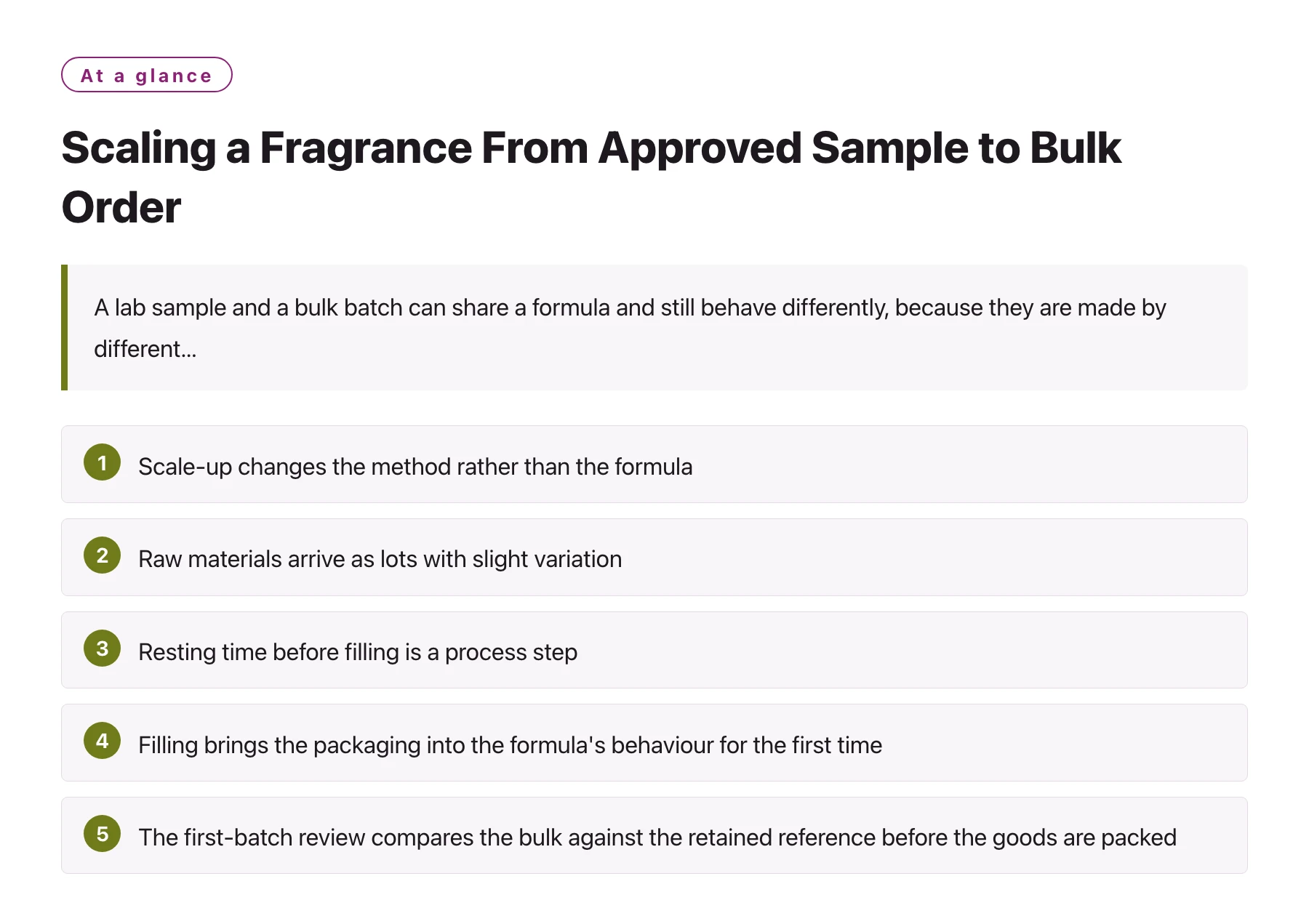
Key takeawaysScale-up changes the method rather than the formula, so the process parameters deserve the same attention as the recipe. · Raw materials arrive as lots with slight variation, which is why a reference sample matters more at production than in the laboratory. · Resting time before filling is a process step, not a formality, and skipping it is a common cause of a batch that smells different. · Filling brings the packaging into the formula's behaviour for the first time, including the seal, the pump and the headspace. · The first-batch review compares the bulk against the retained reference before the goods are packed, when a correction is still cheap.
Approval feels like the end of development and the beginning of production, and the first bulk order is where that assumption gets tested. The formula has not changed, but almost everything around it has.
Material lots differ slightly, weighing tolerances at scale are different from those on a bench, mixing energy is different, and the liquid spends time in stainless steel rather than glass. Any of those can shift how the finished product reads.
None of it is mysterious, and all of it is manageable with a plan agreed before the order is placed.
How to de-risk the first bulk batch
- Ask for a production-scale pilotA short run on the real line reveals behaviour that a laboratory sample cannot, at a fraction of the cost of a failed order.
- Confirm the resting period in writingAsk how long the bulk must rest before filling and whether that time is included in the quoted lead time.
- Agree the sampling planDecide which samples are drawn from the bulk, at which points, and who receives them.
- Fix the acceptance criteria before the runState what will be checked, against which reference, and what happens if the result falls outside the agreed range.
- Book the packaging around the bulk, not before itComponents sitting in a warehouse waiting for a delayed batch tie up cash and can be damaged in storage.
- Review the first batch before packing continuesA comparison against the retained reference at the bulk stage is far cheaper than discovering a problem in filled units.
What actually changes when the volume goes up
Scale-up is usually described as multiplying a recipe, which is misleading. Volume changes the physical conditions of mixing and the logistics of materials far more than it changes the chemistry.
Three shifts explain most of the surprises that appear in the first production run.
Materials arrive in lots, not in grams
A laboratory works from small containers of known history. Production draws from bulk lots, each with its own certificate and its own slight variation, and those lots are combined into a batch of finished product.
This is the main reason a retained reference matters more at production scale than in development. It is the only practical way to tell whether a difference between two batches comes from the material or from the process.
Process parameters become specifications
Mixing order, temperature, agitation time and cooling rate all influence how a fragrance compound blends into its carrier. On a bench these are instincts; on a line they are settings that have to be recorded so the next batch can repeat them.
Formulation and testing coverage in specialist titles such as Cosmetics & Toiletries reflects how much of a product's final behaviour is settled by these manufacturing parameters rather than by the ingredient list alone [1]. Ask for the parameters to be written down, not just performed correctly once.
Filling introduces the packaging
Until filling, the product has only met glass, steel and plastic tubing. At filling it meets the actual bottle, pump, seal and headspace, and the interaction can change the opening of the scent or the way the spray delivers.
This is why a bulk batch that passes every chemical check can still disappoint in the finished unit, and why evaluating the filled sample belongs in the plan.
The same product at two different scales
| Element | At laboratory scale | At production scale | What to verify |
|---|---|---|---|
| Material supply | Small containers with known history | Bulk lots with individual certificates | Lot numbers recorded against the batch |
| Weighing | By hand, one component at a time | Larger tolerances across bigger quantities | That a small error cannot shift the formula |
| Mixing | Glass vessels and visible liquid | Sealed tanks where the process is not visible | Documented settings and times |
| Resting | Often a few days on a shelf | A scheduled stage in the production plan | Agreed duration and a recorded start time |
| Filling | Decanted into the sample bottle | Line filling with weight and volume checks | Yield per batch and rejection rate |
| Record keeping | Notes kept by the perfumer | A batch record that follows the goods | That the record is complete and retrievable |
The last column is the one that supports everything else. A batch record that captures lot numbers, settings, resting time and filling results is what makes a future re-order repeatable, and it is also what makes a complaint investigable rather than arguable.
The classic first-order failure is a batch that arrives, is bottled, packed and shipped, and only then turns out to smell slightly different from the approved sample. By that point the correction cost includes the units, the cartons, the labour and the launch date. Move the comparison earlier: draw a sample from the bulk, compare it against the retained reference, and get written agreement on the result before filling starts. Every supplier that holds the reference sample and runs its own filling line can do this within the existing schedule. A manufacturer such as Xuelei keeps both in one place, which turns that comparison into a routine step rather than a special request.
The checks that keep the batch on schedule
Most late first orders are not caused by a failed batch. They are caused by a step that was omitted and then had to be repeated, which is why the checks below are worth treating as part of the plan rather than as quality assurance after the fact.
Each one has a natural moment, and missing that moment is what turns a small correction into a large delay.
Resting time is not a formality
Blending aroma materials produces a mixture that continues to change for a period after mixing, which is why a resting or maceration stage sits between compounding and filling. A batch filled immediately can read sharp or disjointed for the first weeks of its life.
Ask how long the resting stage is for your product, whether it is included in the quoted lead time, and how the start and end of that period are recorded. A supplier that cannot answer precisely is likely to be treating it as a pause rather than a process step.
Substitutions reopen the assessment
If a material becomes hard to source mid-project, a substitution may be proposed to protect the schedule. Use limits are set according to product type, and the industry material on safe use and fragrance science explains how that assessment framework works [2], so a substitution is a compliance question as well as a technical one.
Treat any substitution as a trigger to re-check the documentation, and expect the schedule to absorb that check rather than the order to absorb the risk.
The first-batch review is a milestone, not a courtesy
Suppliers that have run the same scale-up loop for years, including the Xuelei brand, tend to keep a standard list of questions they ask before the first bulk batch, and that list is a useful preview of where a project is most likely to break.
Put the review in the schedule as a named milestone with a decision attached. Approving the bulk, approving the filled unit and approving the shipped carton are three different decisions, and each one is cheaper to make before the next stage begins.
Sources
- Cosmetics & Toiletries —— A technical magazine for cosmetic formulators, covering ingredients, formulation science and testing methods.
- IFRA: Safe Use and Fragrance Science —— IFRA's explanation of how fragrance materials are scientifically assessed for safe use and how those conclusions are applied by the industry.
Frequently asked questions
Why does my bulk order smell different from the sample I approved?
The usual causes are material lot variation, an insufficient resting period before filling, small weighing differences across a large batch, or evaporation during storage. Ask the manufacturer to compare the bulk against the retained reference sample and to share the batch record before the goods are packed.
What is maceration in perfume production?
It is a resting period after the fragrance compound is blended with its carrier, during which the mixture settles and the scent becomes more cohesive. The length varies by formula and carrier, and it should be a scheduled production step with a recorded start and finish rather than an informal pause.
Should the first production run be a full order?
Not necessarily. A smaller production-scale pilot on the real line reveals most of the behavioural differences at a fraction of the risk, and it produces a bulk reference you can compare against the full order. It is particularly worth doing when the format or the packaging is new.
How long does it take to go from approved sample to bulk delivery?
It depends on material lead times, the resting period, component availability and the filling schedule, so the honest answer comes from the supplier's own plan. Ask for those four elements separately, since a single total figure hides whichever one is actually driving the date.
What should a batch record contain?
At minimum the batch number, material lot numbers, quantities, mixing settings and times, the resting period, filling results and yield, plus the name of the person who released the batch. A complete record makes a future re-order repeatable and turns a complaint into a measurable comparison.