How Do You Choose the Right Industrial Hose for Your Application?
Choosing the right industrial hose starts with six measurable conditions: media, temperature, pressure, inside diameter, bend radius, and connection type. A hose carrying mineral-based hydraulic oil at 90°C needs a different tube compound from one moving water, steam, dry cement, or food products. ISO 18752:2025, for example, covers hydraulic hose sizes from nominal 5 to 102 and permits selected oil-service types from −40°C to 120°C. Pressure must be checked at assembly level because the lowest-rated hose, fitting, seal, or coupling sets the usable limit. Material compatibility and actual operating conditions should be checked before price, brand, or appearance.
A useful specification starts with the fluid because the inner tube can remain in continuous contact with it for hundreds or thousands of operating hours. NBR is widely used with petroleum oils and fuels, while EPDM is commonly used with water, hot water, and many non-petroleum fluids. PTFE offers broad resistance to many industrial chemicals and can operate at temperatures beyond the range of common rubber compounds. ISO 18752:2025 lists oil-based hydraulic fluid service from −40°C to 100°C for AS, AC, BS, and BC hose types and up to 120°C for CS, CC, and DC types.
Fluid name alone is not enough. A 10% chemical solution may behave differently from the same chemical at 50% concentration, and resistance at 20°C does not guarantee the same service life at 80°C. Suppliers should receive the full chemical name, concentration, operating temperature, cleaning chemical, and expected contact time. Mixed chemicals deserve separate review because seals, tube compounds, and metal fittings may react differently.
A hose marked for “chemical service” is not automatically compatible with every acid, solvent, oxidizer, or alkaline solution. Compatibility tables should be checked against the manufacturer’s exact compound, not only the generic polymer family.
Once the media is established, pressure becomes easier to specify. Normal operating pressure, short pressure surges, pump pulsation, and vacuum conditions should be listed separately. SAE J517:2020 states that the maximum working pressure of a hydraulic hose assembly cannot exceed the lower working-pressure rating of the hose and its connectors. A 3,000 psi hose therefore cannot be treated as a 3,000 psi assembly when the installed coupling is rated for 2,500 psi.
| Operating condition | What to specify | Why it matters |
|---|---|---|
| Continuous pressure | Normal psi or bar | Used for normal hose rating |
| Pressure surge | Highest expected psi or bar | Repeated spikes can shorten service life |
| Vacuum | Vacuum level or percentage | Standard pressure hose may collapse |
| Pulsation | Cycles and frequency | Reinforcement experiences repeated flexing |
| Shutdown state | Trapped pressure | Pressure may remain after equipment stops |
Pressure also changes with temperature. A hose rated at room temperature may require a lower operating pressure at elevated temperatures, depending on its compound and construction. Manufacturer derating tables should therefore be used whenever process temperature approaches the hose’s upper range. In 2025, ISO 18752 separated temperature capability by hose type rather than treating all reinforced hydraulic hoses as interchangeable.
Diameter comes next because size affects velocity and pressure loss, not only fitting compatibility. Moving 100 liters per minute through a small-bore hose produces much higher fluid velocity than sending the same flow through a larger bore. Higher velocity generally increases frictional loss, heat, noise, and erosion where abrasive material is present. A hose selected only because its thread matches the machine can therefore restrict an otherwise correctly sized pump circuit.
Length deserves equal attention. A hose that is 5% too short may be pulled tight when a cylinder, boom, platform, or machine axis moves through its full travel. Tensile force then reaches the coupling area, where movement should normally be limited. Excessive length creates loops that may rub against frames or moving parts. Routing should be checked through the entire machine motion, not only while the equipment is parked.
Bend radius should be compared with the manufacturer’s minimum figure before installation. If a hose requiring a 150 mm minimum bend radius is forced around an 80 mm corner, its cross-section can flatten and reinforcement wires can carry uneven stress. Repeated bending near the fitting is especially undesirable because the transition between flexible hose and rigid coupling concentrates movement into a short section.
For applications with frequent movement, industrial hose solutions should be compared by bend radius, reinforcement construction, abrasion resistance, temperature range, and coupling compatibility rather than by diameter alone. A hose on stationary processing equipment may flex only during maintenance, while one on a reel can bend thousands of times during its working period. The same nominal pressure rating does not describe those mechanical differences.
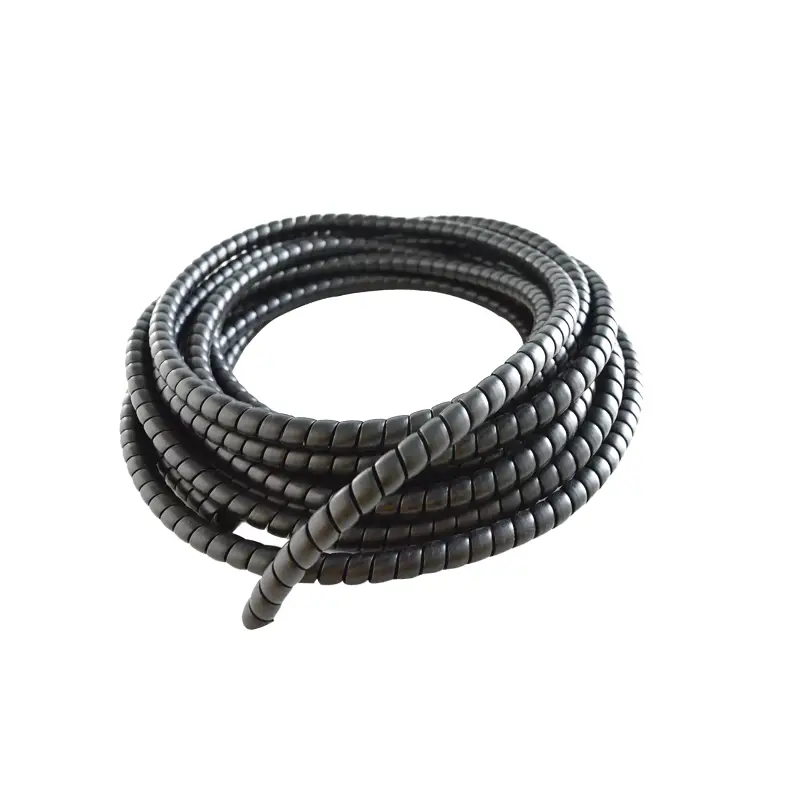
The outside environment should then be added to the specification. A cover may face sunlight, ozone, rain, petroleum splash, hot metal, road debris, or repeated contact with concrete. A hose operating outdoors for 100% of its service time needs different cover properties from one protected inside a climate-controlled plant. Sleeves and guards can reduce rubbing, although they do not correct an unsuitable hose compound or poor routing.
-
For outdoor use, check UV, ozone, and weather resistance.
-
For floor-drag applications, compare cover abrasion data.
-
Near engines or furnaces, measure ambient temperature at the hose position.
-
Around moving machinery, keep the hose clear of pinch points and rotating parts.
-
Where electrical continuity is required, verify resistance for the complete assembly rather than assuming exposed wire reinforcement provides it.
Internal abrasion requires another set of measurements. Sand, cement, mineral slurry, pellets, grain, and dry powders can remove tube material as particles strike the wall. Wear normally increases as velocity rises, and elbows or hose bends receive more particle impact than straight sections. If a process operates 2 shifts per day for 300 days a year, small differences in wear rate can become significant long before the hose shows external damage.
For abrasive service, record particle type, approximate particle size, solids percentage, flow rate, and whether the product is dry or suspended in liquid. “Powder hose” or “slurry hose” provides too little information for a reliable selection.
Temperature must include cleaning as well as production. A beverage hose may carry product at 10°C but later receive an 80°C cleaning solution. A process-water hose may normally operate at 40°C yet experience periodic hot-water sanitation. Selecting from the production temperature alone overlooks part of the hose’s exposure. Steam service needs still more care because temperature, pressure, condensate, and repeated heating and cooling act together.
ISO 18752:2025 gives another useful comparison: water-based hydraulic fluids listed under the standard are covered from −40°C to 70°C, while several oil-based fluid hose types are specified up to 100°C or 120°C. The same hose construction cannot therefore be assumed suitable for every fluid merely because its pressure rating appears adequate.
Fittings should be specified after hose size, media, pressure, and temperature are known. Common industrial arrangements include cam-and-groove couplings, flanges, threaded ends, sanitary connections, and application-specific quick couplings. Seal materials also matter. An EPDM seal and an FKM seal can behave very differently in oils, fuels, hot water, and aggressive chemicals.
The assembly method belongs in the same specification. Crimp dimensions, ferrules, clamps, stems, and hose construction are normally designed as a matched system. SAE J517 has addressed hydraulic hose performance since its original issue in 1952, yet its assembly principle remains straightforward: the permitted working pressure is limited by the lower-rated component. Replacing one fitting with a visually similar part is not enough to establish equal performance.
Food, pharmaceutical, marine, and electrically sensitive applications add separate requirements. In the United States, food-contact rubber articles may be evaluated against requirements such as 21 CFR 177.2600 where applicable, while marine hydraulic installations can involve SAE J1475, SAE J1942, and SAE J1942-1. A plant specification should name the required regulation or standard instead of using broad descriptions such as “food grade” or “marine quality.”
A purchase request can be reduced to a compact data sheet:
| Required information | Example entry |
|---|---|
| Media | Mineral hydraulic oil |
| Concentration | 100% |
| Flow | 75 L/min |
| Normal pressure | 180 bar |
| Maximum pressure | 220 bar |
| Media temperature | −20°C to 95°C |
| Ambient temperature | −30°C to 70°C |
| Inside diameter | 19 mm |
| Minimum available bend radius | 180 mm |
| Movement | Repeated machine articulation |
| Ends | Specified thread and fitting series |
| Environment | Outdoor, oil splash, abrasion |
| Cleaning | None |
| Standard | ISO 18752:2025 where applicable |
Inspection frequency can then be based on how the hose is actually used. Equipment working 2,000 hours per year with continuous flexing should not automatically follow the same inspection interval as a stationary transfer line used 100 hours annually. Inspection records should note cover cuts, exposed reinforcement, leaks, blistering, hardening, flattening, fitting corrosion, and coupling movement.
Replace condition-based assumptions with measured operating data. A hose specification containing pressure, temperature, fluid composition, diameter, flow, bend radius, movement, fitting type, external exposure, and applicable 2025 or current industry standards gives the supplier enough information to match the assembly to the service rather than selecting from nominal size and price alone.